

A real estate investment advisor helps investors source, evaluate, finance, manage, and optimize investment property, and stays involved across the whole life of the asset rather than just closing a transaction.
That is what separates an advisor from a broker or agent, who is usually paid to complete a single deal and then moves on.
For an investor building or scaling a portfolio, that difference matters. An advisor gives strategic support before, during, and after an acquisition, from identifying opportunities and analyzing risk to structuring financing, improving performance, and planning the exit.
Elkridge Real Estate takes this end-to-end approach across sourcing, acquisition, financing, value creation, operations, and exit planning.
Rather than focusing only on closing a transaction, Elkridge helps investors acquire, optimize, and scale real estate assets through long-term advisory support.
Whether you are acquiring your first commercial property or expanding an existing portfolio, partnering with an experienced advisor can help you make stronger investment decisions, reduce unnecessary risks, and create more value throughout ownership.
What a Real Estate Investment Advisor Does
A real estate investment advisor provides strategic guidance that extends far beyond helping
investors purchase property.
Their role is to help investors evaluate opportunities, allocate capital effectively, and develop strategies that improve portfolio performance over time.
Common real estate advisory services include:
- Identifying investment opportunities that align with investor objectives
- Performing financial analysis and market research
- Conducting due diligence before acquisitions
- Evaluating financing options
- Developing value-add strategies
- Improving asset performance
- Planning refinancing or disposition strategies
- Supporting portfolio growth
Instead of recommending properties simply because they are available, a real estate investment advisor evaluates whether an opportunity supports the investor’s financial goals and broader investment strategy.
For example, Company A has $8 million available to invest in commercial real estate.
Rather than purchasing the first attractive property on the market, the advisor reviews multiple opportunities, analyzes projected cash flow, estimates capital improvement costs, and evaluates potential long-term value before recommending an investment approach.
This process allows investors to compare opportunities objectively and make decisions based on financial analysis rather than assumptions.
How It Differs From a Broker or Agent
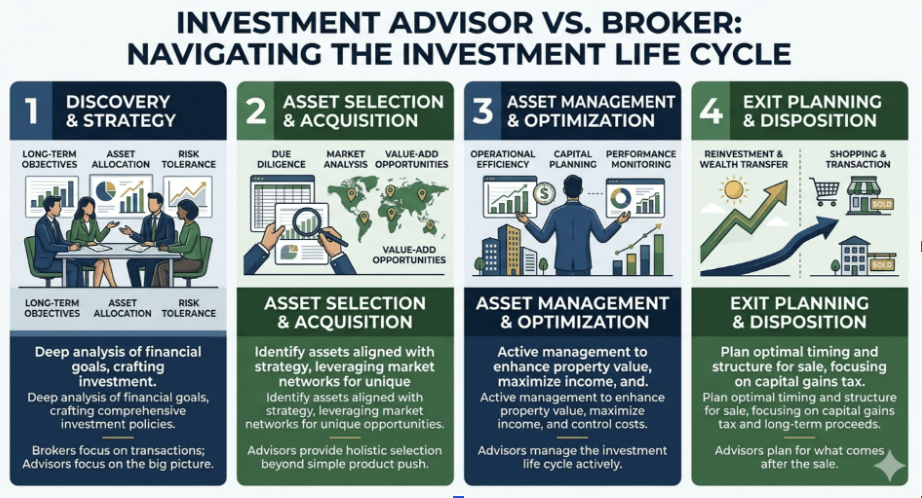
The clearest difference is how each is paid and what that payment is designed to cover.
A broker or agent typically earns a commission when a transaction closes, while a real estate advisor is paid for ongoing guidance throughout the investment process.
That difference can affect incentives.
A broker has a financial reason to help move a transaction toward closing, while an advisor can focus on whether the opportunity actually fits the investor’s strategy, financial goals, and risk tolerance.
If a property does not make sense, an advisor can recommend walking away rather than pushing the deal forward.
For an investor deploying significant capital, that alignment can be more valuable than the advisory fee itself.
Beyond compensation, the scope of support is also different. A broker or agent typically focuses on facilitating a transaction, from identifying properties to negotiating and closing a deal.
A real estate investment advisor takes a broader view, helping investors evaluate opportunities, structure financing, create value, manage risks, and plan for the eventual exit.
That broader perspective matters when an investment decision extends far beyond the closing date.
Looking for guidance beyond the transaction itself? Elkridge Real Estate helps investors evaluate opportunities and make decisions across the full investment lifecycle.
The Full Lifecycle They Cover: Sourcing to Exit
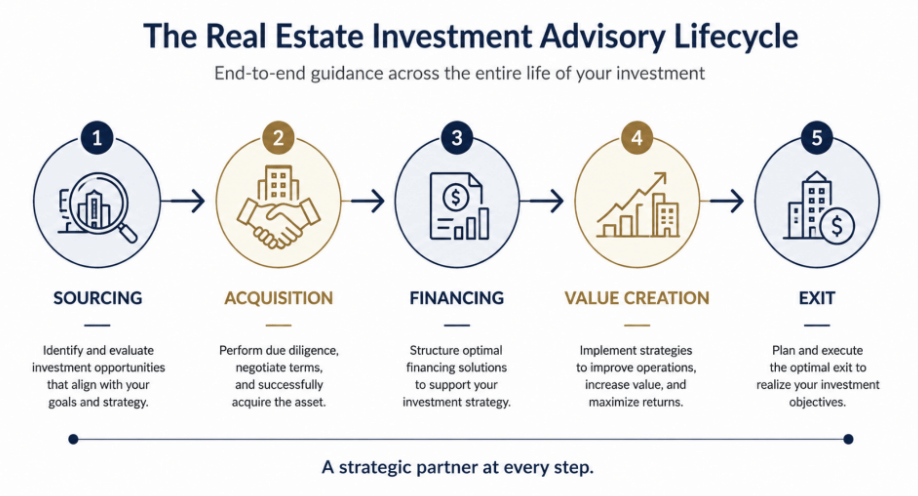
One of the biggest advantages of working with a real estate investment advisor is having guidance throughout the entire ownership period, not only during the initial acquisition.
A strong advisory relationship covers every stage of the investment lifecycle, helping investors make informed decisions from sourcing opportunities through eventual exit planning.
Sourcing
The process begins with identifying opportunities that align with the investor’s objectives.
Rather than reviewing properties based only on availability, an advisor evaluates whether an asset fits the investor’s financial goals, risk tolerance, and portfolio strategy.
Acquisition
During acquisition, the advisor helps investors analyze potential purchases, evaluate pricing, negotiate terms, and coordinate due diligence.
This process helps investors understand the strengths and risks of an opportunity before committing capital.
Financing
Choosing the right financing structure can significantly impact investment performance.
A real estate advisor evaluates available options and helps investors determine financing strategies that support their objectives.
This may include reviewing debt structures, capital requirements, and refinancing opportunities.
Value Creation
The advisor’s role continues after acquisition by identifying ways to improve the property’s performance and increase its value.
Strategies may include:
- Renovations and property improvements
- Operational improvements
- Lease restructuring
- Tenant optimization
- Expense reduction
For example, Company B purchases an office building for $12 million.
After analyzing the asset, the advisor identifies opportunities to modernize common areas, improve occupancy, and optimize lease agreements.
Over time, these improvements increase income generation and strengthen the property’s overall market value.
Exit Planning
Successful investors do not wait until the last moment to think about selling.
Exit strategies are often developed years before a property is placed on the market.
A real estate investment advisor helps investors evaluate market conditions, timing, valuation expectations, and potential buyers to create a stronger exit strategy.
By supporting investors throughout the entire asset lifecycle, advisors help create value beyond the initial purchase.
When an Investor Needs One
While every investor can benefit from professional guidance, there are situations where working with a real estate advisor becomes especially valuable.
Investors may benefit from advisory support when they are:
- Purchasing their first commercial property
- Expanding into new markets
- Building a diversified portfolio
- Evaluating multiple investment opportunities
- Raising capital for acquisitions
- Planning significant property improvements
- Preparing to refinance or sell assets
For example, Company A owns one retail property and wants to expand into multiple industrial facilities valued at more than $30 million.
Without a structured acquisition strategy, financing plan, and portfolio analysis, rapid growth can create unnecessary risks and inefficient capital allocation.
A commercial real estate advisor provides the analysis and strategic direction needed to support sustainable expansion.
Ready to evaluate your next investment opportunity? Book a strategy call with Elkridge Real Estate.
What to Look For
Not every real estate advisor provides the same level of expertise or support.
Investors should evaluate whether an advisor has the experience and capabilities needed to support their long-term goals.
When selecting an advisor, consider whether they offer:
- Experience across multiple property types
- Strong financial analysis skills
- Market research expertise
- Acquisition support
- Financing guidance
- Asset management knowledge
- Exit planning experience
- Transparent communication
- Long-term strategic involvement
The strongest advisory relationships are built on trust, objective analysis, and alignment between the investor’s goals and the advisor’s approach.
Rather than choosing an advisor focused only on completing a transaction, investors should look for a partner who understands how to create value throughout the ownership journey.
How Advisors Are Paid
Understanding compensation structures helps investors determine whether advisory services provide value based on their specific needs.
Real estate advisory services may involve different fee structures, including:
- Fixed consulting fees
- Retainer agreements
- Asset management fees
- Acquisition fees
- Performance-based compensation
- Hybrid fee structures
Unlike traditional brokers who generally earn a commission when a transaction closes, advisors are often compensated for ongoing involvement and strategic support throughout the investment process.
This structure encourages a focus on long-term performance rather than simply completing an individual deal.
Before engaging an advisor, investors should understand what services are included, how fees are calculated, and how compensation aligns with investment objectives.
Is It Worth It?
For investors making significant real estate investments, the value of professional guidance often extends beyond the cost of advisory services.
A real estate investment advisor can help investors:
- Avoid costly acquisition mistakes
- Improve financing decisions
- Identify opportunities to increase asset value
- Strengthen operational performance
- Plan effective exits
- Build scalable investment portfolios
The value of an advisor is not only measured by the properties acquired, but also by the quality of decisions made throughout ownership.
Elkridge Real Estate provides end-to-end real estate advisory services for investors seeking to acquire, optimize, and scale assets.
From sourcing opportunities and structuring acquisitions to improving operations and planning exits, Elkridge supports investors across the entire asset lifecycle.
Frequently Asked Questions
What is a real estate advisor?
A real estate advisor is a professional who helps investors evaluate, acquire, finance, manage, optimize, and eventually sell investment properties.
Unlike brokers or agents who typically focus on completing individual transactions, advisors provide ongoing strategic guidance throughout the asset lifecycle.
Do I need a real estate advisor?
Investors who are acquiring commercial properties, expanding portfolios, investing significant capital, or planning long-term growth may benefit from working with a real estate investment advisor.
An advisor can help evaluate opportunities, reduce risk, improve decision-making, and develop strategies that support long-term investment goals.
What is the difference between a real estate advisor and a broker?
A broker is usually paid a commission to complete a transaction, so their involvement often ends at closing.
A real estate advisor is paid for ongoing guidance and stays involved across sourcing, financing, operations, and exit.
This aligns their role with the long-term performance of the investment rather than a single transaction.
How are real estate advisors paid?
Advisory fees vary and can include fixed consulting fees, retainers, asset management fees, acquisition fees, performance-based compensation, or a hybrid structure.
Unlike a broker’s transaction commission, advisory fees are usually tied to ongoing involvement and a broader scope of services.
Investors should confirm what is included and how fees are calculated before engaging an advisor.
Conclusion
Choosing the right real estate advisor can influence far more than a single acquisition.
The right partner helps investors identify opportunities, evaluate risks, structure financing, improve asset performance, and plan successful exits with greater confidence.
Elkridge Real Estate works with investors throughout the entire asset lifecycle, helping them acquire, optimize, and scale real estate assets through strategic advisory support.
Disclaimer: This article is provided for educational purposes only and does not constitute investment, tax, or legal advice. Real estate investing involves risk, and outcomes may vary based on individual circumstances. Any figures presented are illustrative examples and should not be interpreted as projected returns. Consult a qualified professional before making any investment decision.