

“What is a cap rate?” is one of the first questions real estate investors ask when evaluating potential acquisitions.
The capitalization rate, or cap rate, measures a property’s annual net operating income (NOI) compared to its market value or purchase price, helping investors estimate potential unleveraged returns and compare income-producing opportunities.
However, cap rate is only one part of a complete investment analysis.
Factors such as property quality, market conditions, tenant stability, and long-term growth potential also play a critical role in determining an asset’s true value.
At Elkridge Real Estate, we help investors evaluate opportunities through financial analysis and strategic market insights to make informed acquisition decisions.
What Is a Cap Rate?
A cap rate, or capitalization rate, is a real estate metric used to estimate the potential annual return of an income-producing property.
It is calculated by dividing a property’s net operating income (NOI) by its purchase price or market value.
In simple terms, the cap rate meaning shows how much income a property generates relative to its value.
Investors use cap rate real estate analysis to compare potential acquisitions and assess whether a property’s income justifies its price.
For example, Company A evaluates a property worth $2,000,000 that generates $160,000 in annual NOI, resulting in an 8% cap rate.
Company B evaluates a $2,500,000 property generating $150,000 in NOI, resulting in a 6% cap rate.
Although Company B’s property is more expensive, Company A’s generates a higher return relative to its value.
Generally, a higher cap rate may indicate higher potential returns but also greater risk, while a lower cap rate often reflects a more stable asset in a stronger market.
Investors should evaluate cap rate alongside market conditions, property quality, tenant stability, and long-term growth potential.
The Cap Rate Formula: NOI Divided by Value
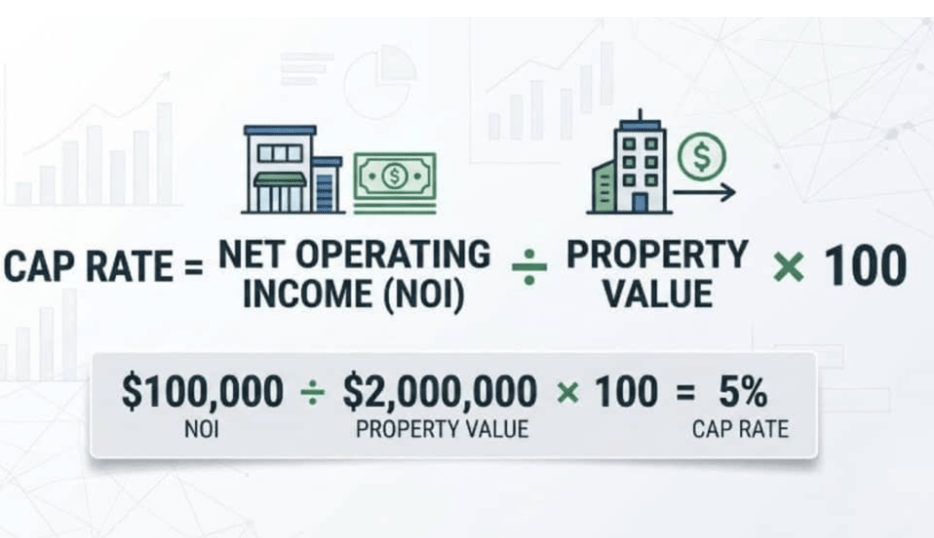
The cap rate formula is:
Cap Rate = Net Operating Income (NOI) ÷ Property Value × 100
This calculation measures a property’s annual unleveraged return based on its operating income and market value, without considering financing.
Example:
Property value: $2,500,000
Annual NOI: $200,000
$200,000 ÷ $2,500,000 = 8% cap rate
Investors use this percentage to compare income-producing properties and assess how efficiently each generates income relative to its value.
However, cap rate should always be considered alongside factors such as location, tenant quality, and market risk.
How To Find Net Operating Income
To calculate a property’s cap rate, investors must first determine its net operating income (NOI).
NOI is the income a property generates after operating expenses, but before debt payments, taxes, depreciation, and financing costs.
Formula:
Gross Rental Income – Operating Expenses = Net Operating Income
Gross rental income includes rent and other property-related revenue, while operating expenses include management fees, maintenance, insurance, property taxes, utilities, and administrative costs.
Example:
Annual rental income: $500,000
Operating expenses: $150,000
NOI: $350,000
If the property is valued at $5,000,000:
$350,000 ÷ $5,000,000 = 7% cap rate
Because cap rate depends on NOI, investors should verify financial statements, lease agreements, and historical operating performance before evaluating an acquisition.
A Worked Example
Understanding what is a cap rate becomes easier with a practical example.
Company A is evaluating a multifamily property priced at $4,000,000 with an annual NOI of $400,000, resulting in a 10% cap rate.
A comparable property owned by Company B is priced at $5,000,000 with the same NOI of $400,000, resulting in an 8% cap rate.
Although Company A’s property has the higher cap rate, that does not automatically make it the better investment.
Company B’s lower cap rate may reflect advantages such as a stronger location, higher tenant demand, or greater long-term growth potential.
This example shows why investors should use cap rate alongside market conditions, property quality, and other financial considerations.
What Is A Good Cap Rate? Depends On Market, Asset Class, And Risk
One of the most common questions investors ask is: what is a good cap rate?
The answer depends on the property’s location, asset type, market conditions, and level of risk.
There is no single cap rate percentage that represents a good investment in every situation.
A lower cap rate may reflect a stable property in a highly competitive market, while a higher cap rate may indicate greater risk or uncertainty.
Several factors influence whether a cap rate is attractive:
Property Type: Different asset classes, including multifamily, industrial, office, and retail properties, have different levels of demand, income stability, and operating risk.
Location: Properties in strong markets with consistent demand often trade at lower cap rates, while properties in less established markets may offer higher cap rates due to increased risk.
Market Conditions: Interest rates, economic trends, and investor demand can affect both cap rates and property valuations.
Risk Profile: Properties with stable tenants and predictable income may justify lower cap rates, while assets with operational challenges may require higher returns.
For example, Company A may acquire a commercial property with a 6% cap rate in a strong market, while Company B purchases a similar property with a 9% cap rate in a higher-risk area.
Although Company B shows a higher return, the additional risk may impact long-term performance.
Understanding what is a good cap rate requires balancing expected returns with investment risk.
The right cap rate depends on the investor’s goals, strategy, and market conditions.
At Elkridge Real Estate, we help investors assess whether a property’s potential return is appropriate for its market, asset class, and risk profile.
Cap Rate vs Other Metrics: Cash on Cash Return and ROI
While cap rate is an important real estate metric, investors typically use it alongside other measurements to evaluate an opportunity more completely.
Metrics such as cash-on-cash return and return on investment (ROI) provide additional insight into financing impact and overall profitability.
| Metric | What It Measures | Key Formula / Focus | Best Used For |
| Cap Rate | Property-level income performance | NOI ÷ Property Value | Comparing income-producing properties |
| Cash-on-Cash Return | Return on the investor’s actual cash invested | Annual Cash Flow ÷ Cash Invested | Evaluating financing and cash flow |
| ROI | Overall investment profitability | Total Gain ÷ Total Investment | Measuring long-term investment performance |
These metrics are complementary rather than interchangeable.
Using them together gives investors a clearer view of both current property performance and potential long-term returns.
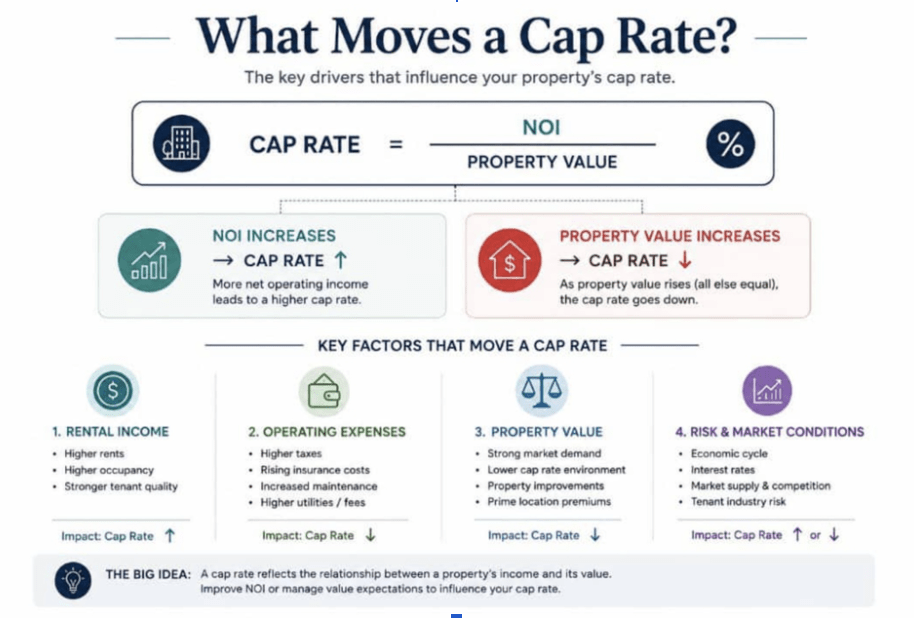
What Moves A Cap Rate?
Cap rates are not fixed numbers. They change based on market conditions, property performance, investor demand, and perceived risk.
Key factors that influence cap rates include:
Interest Rates: Higher borrowing costs may cause investors to require higher returns, which can increase cap rates and affect property values.
Location: Properties in strong markets with stable demand often have lower cap rates, while properties in less established areas may trade at higher cap rates due to increased risk.
Asset Class: Different property types, including multifamily, industrial, office, and retail, have different levels of income stability and risk, resulting in different cap rate expectations.
Income Stability: Properties with reliable tenants, long-term leases, and predictable cash flow may support lower cap rates, while uncertain income may require higher returns.
Supply and Demand: Strong buyer competition can increase property values and lower cap rates, while weaker demand may lead to higher cap rates.
Understanding cap rate real estate trends requires evaluating both the property and the broader market environment.
Limits Of Cap Rate
Although cap rate is a valuable tool for evaluating real estate investments, it has limitations and should not be the only factor investors consider.
Cap Rate Does Not Consider Financing
Cap rate measures a property’s operating performance before debt payments, interest costs, or loan structure.
As a result, investors purchasing the same property may achieve different returns depending on their financing strategy.
Cap Rate Does Not Measure Future Growth
Cap rate reflects current income and value but does not account for future appreciation, rental growth, or market expansion potential.
Cap Rate Depends on Accurate Financial Information
The accuracy of a cap rate depends on reliable financial data. Incorrect assumptions about income, expenses, or vacancy rates can create misleading results.
Cap Rate Does Not Replace Due Diligence
Investors should evaluate cap rate alongside other factors, including property condition, tenant quality, market trends, and operational risks, before making an investment decision.
Frequently Asked Questions
What Is A Cap Rate?
A cap rate, or capitalization rate, measures a property’s annual net operating income (NOI) compared to its market value or purchase price.
It is calculated by dividing NOI by property value and expressing the result as a percentage.
What Is A Good Cap Rate?
There is no universal answer to what is a good cap rate.
The ideal percentage depends on factors such as property type, location, market conditions, and investment risk.
A higher cap rate may indicate greater potential returns but may also involve higher risk.
What Is Cap Rate In Real Estate?
Cap rate in real estate is a metric investors use to evaluate the income potential of an income-producing property relative to its value.
It helps compare investment opportunities but should be considered alongside other factors, including financing, market conditions, and growth potential.
How Is Cap Rate Calculated?
Cap rate is calculated using the formula:
Cap Rate = Net Operating Income (NOI) ÷ Property Value × 100
Conclusion
Understanding what is a cap rate helps investors quickly compare real estate opportunities and evaluate potential returns.
However, cap rate is only one part of a successful investment analysis. Market conditions, asset quality, financing strategy, and long-term value potential must also be considered.
At Elkridge Real Estate, we help investors evaluate potential acquisitions through financial analysis and strategic market insights.