

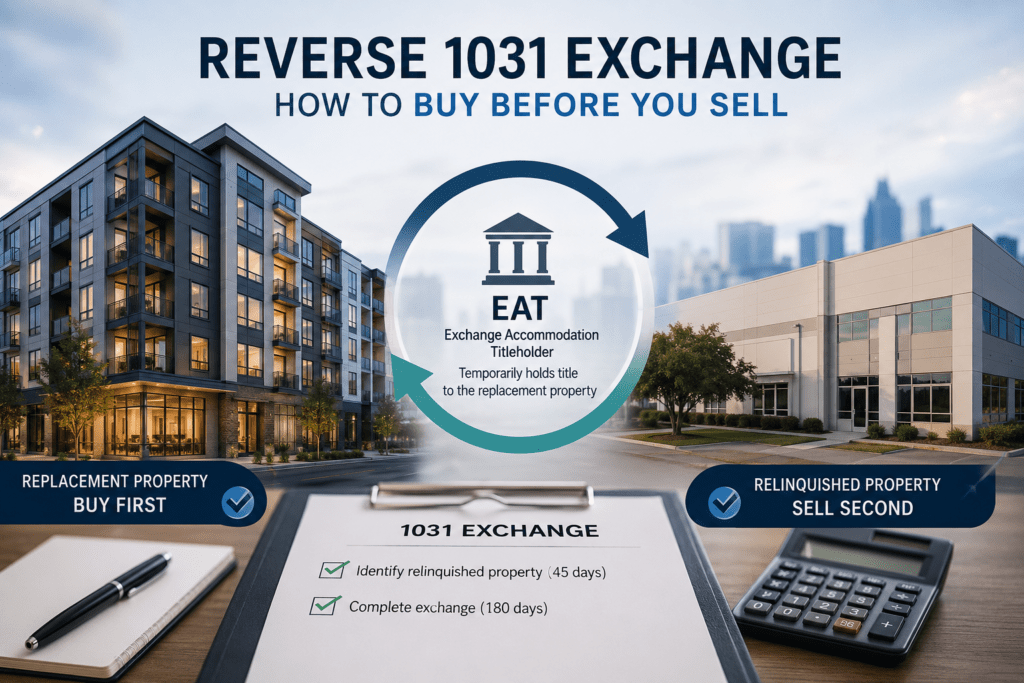
A reverse 1031 exchange lets a real estate investor buy the replacement property before selling the one they are giving up, using an Exchange Accommodation Titleholder (EAT) to hold title to the new property in the meantime.
It follows the same tax-deferral rules as a standard 1031 exchange, but in the opposite order, which makes it useful in competitive markets where you need to secure the property first.
It is governed by IRS Revenue Procedure 2000-37, which created a safe harbor for buying before selling.
The trade-off is more complexity and cost, so it works best as a planned strategy, not a last-minute fix.
What Is a Reverse 1031 Exchange
Many investors ask, what is a reverse 1031 exchange and how it differs from a standard 1031 exchange.
A reverse 1031 exchange allows an investor to acquire a replacement property before selling an existing investment property.
Since investors generally cannot own both properties directly during the exchange process, an Exchange Accommodation Titleholder (EAT) temporarily holds title to the replacement property until the original property is sold and the exchange requirements are completed.
This strategy is particularly valuable when market conditions require investors to act quickly.
For example, an investor may identify a high-performing multifamily property while their current asset is still on the market.
Instead of risking the loss of the opportunity, a reverse exchange allows the investor to secure the replacement property first.
For example, Company A owns a commercial property valued at $5 million and wants to transition into a larger multifamily asset.
Before selling the existing property, Company A identifies a multifamily investment priced at $5.5 million.
Because the new property aligns with its long-term strategy, Company A uses a reverse 1031 exchange to acquire the asset while completing the sale of the original property.
Investors should evaluate whether this structure supports their financial goals, available capital, and long-term portfolio strategy.
How it works – The Exchange Accommodation Titleholder And The Parking Arrangement
A reverse 1031 exchange relies on an Exchange Accommodation Titleholder (EAT), a third-party entity that temporarily holds ownership of the replacement property during the exchange period.
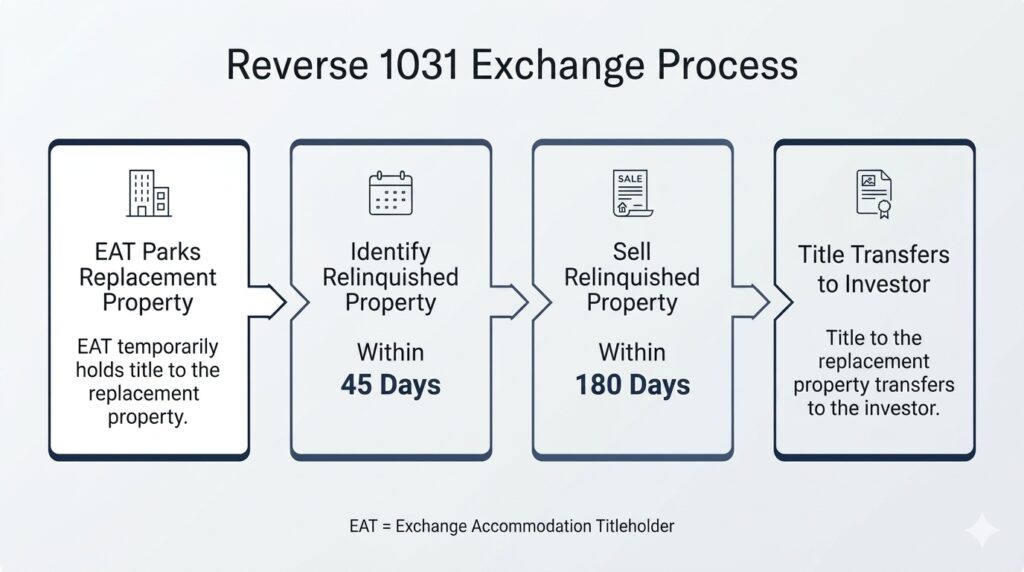
The process generally includes the following steps:
- The investor identifies a replacement property.
- The EAT acquires and temporarily holds title to the property through a parking arrangement.
- The investor sells the relinquished property within the required timeframe.
- Ownership of the replacement property transfers to the investor after exchange requirements are satisfied.
The parking arrangement allows investors to buy first while maintaining eligibility for potential tax deferral under 1031 exchange rules.
For example, Company B discovers an industrial warehouse in a market with limited inventory.
Waiting several months to sell its existing property could cause Company B to lose the opportunity to another buyer.
Through a reverse exchange structure, the EAT temporarily holds the warehouse while Company B completes the sale of its current asset.
Because this process involves multiple parties, investors should coordinate closely with lenders, tax professionals, legal advisors, and real estate specialists.
When To Use One. Buying First In A Hot Market
A reverse 1031 exchange is most beneficial when an investor needs to secure a property before selling an existing asset.
This situation often occurs in competitive markets where attractive properties receive multiple offers or become unavailable quickly.
Investors may consider this strategy when:
- A unique investment opportunity becomes available.
- Waiting for a property sale could result in losing the replacement asset.
- Market conditions make timing critical.
- The replacement property offers stronger long-term potential.
For example, Company A owns a stable-income retail property but identifies a mixed-use development opportunity with significant growth potential.
Because several buyers are interested, waiting until the retail property sells could prevent Company A from acquiring the new asset.
A reverse exchange allows the investor to secure the opportunity while creating a structured plan for selling the existing property.
However, investors should not use a reverse exchange only because of market pressure.
The replacement property should still meet investment objectives related to cash flow, risk, and long-term growth.
For example, Company A owns a stable-income retail property but identifies a mixed-use development opportunity with significant growth potential.
Because several buyers are interested, waiting until the retail property sells could prevent Company A from acquiring the new asset.
A reverse exchange allows the investor to secure the opportunity while creating a structured plan for selling the existing property.
However, investors should not use a reverse exchange only because of market pressure.
Reverse 1031 Exchange Timeline: The 45 And 180 Day Windows Still Apply
Understanding the reverse 1031 exchange timeline is essential because investors must follow strict IRS requirements.
The two key deadlines include:
45 days: The investor must identify the relinquished property within this period after the replacement property is acquired.
180 days: The entire exchange must be completed within this timeframe.
Missing a deadline does not automatically void the transaction, but it takes you outside the Rev. Proc.
2000-37 safe harbor, which means losing its protection and facing far greater IRS scrutiny.
In practice, staying inside the safe harbor is what you are paying for, so the deadlines should be treated as absolute.
Because reverse exchanges involve several moving parts, including financing, property sales, and legal documentation, early planning is critical.
Investors should prepare before acquiring the replacement property to avoid delays that could impact the exchange.
Proper coordination between investors, advisors, lenders, and exchange specialists helps reduce unnecessary risks and keeps the transaction on track.
Elkridge Real Estate helps investors develop acquisition strategies and transaction plans designed around their long-term investment objectives.
Pros And Cons
A reverse 1031 exchange provides investors with greater flexibility, but it also involves additional complexity compared with a traditional exchange.
Understanding the benefits and challenges helps investors determine whether this approach fits their strategy.
Benefits of a reverse 1031 exchange include:
Ability to buy before selling: Investors can secure a desirable property without waiting for their current asset to close.
Competitive advantage: Investors can act quickly in markets where attractive properties are limited.
Potential tax deferral: When properly structured, investors may defer capital gains taxes and preserve more capital for future investments.
Greater control over timing: Investors have more flexibility when transitioning between properties.
Potential challenges include:
Higher costs: Reverse exchanges usually require additional fees due to EAT services, professional support, and transaction complexity.
More coordination: Investors must work with multiple parties, including lenders, attorneys, and exchange specialists.
Strict deadlines: Failure to meet IRS requirements can affect the exchange outcome.
Financing considerations: Some lenders may require additional documentation due to temporary property ownership.
A reverse exchange should be evaluated as part of a broader investment plan rather than as a solution for timing alone.
How Much Does A Reverse 1031 Exchange Cost
One common question investors ask is how much does a reverse 1031 exchange cost.
The total cost varies depending on the transaction complexity, property value, financing structure, and professional services required.
Common expenses may include:
- Exchange Accommodation Titleholder (EAT) fees.
- Qualified intermediary fees.
- Legal and tax advisory costs.
- Additional closing and financing expenses.
Because reverse exchanges involve more coordination than traditional 1031 exchanges, investors should expect higher upfront costs.
However, these expenses should be weighed against the potential benefit of securing a valuable asset and preserving capital through tax deferral.
Investors should evaluate the cost in relation to long-term factors such as cash flow, appreciation potential, and portfolio growth.
Reverse VS Standard 1031
Both standard and reverse 1031 exchanges can allow investors to defer capital gains taxes on qualifying properties.
The key difference is the order in which the properties are acquired and sold.
| Feature | Standard 1031 Exchange | Reverse 1031 Exchange |
Transaction order | Sell first, then acquire | Acquire first, then sell |
Replacement property | Acquired after the original property is sold | Acquired before the original property is sold |
EAT involvement | Generally not required to hold the replacement property | EAT temporarily holds the replacement property |
Best suited for | Situations where the investor can sell first | Competitive markets where the investor needs to secure a property first |
Key consideration | Requires identifying and acquiring a replacement property within the applicable timeframe | Requires careful planning around financing, timing, and EAT arrangements |
A standard exchange may work well when the investor has flexibility around timing, while a reverse exchange can be useful when an attractive replacement property becomes available before the existing property is sold.
Choosing the right structure depends on the investor’s timing, financing, property goals, and transaction circumstances.
Book a strategy call to decide which exchange structure fits your next move.
Frequently Asked Questions
What is a reverse 1031 exchange?
A reverse 1031 exchange allows an investor to purchase a replacement property before selling an existing investment property.
An Exchange Accommodation Titleholder temporarily holds ownership of the property while the investor completes the sale of the relinquished asset according to exchange requirements.
This strategy is commonly used in competitive markets where waiting for a sale could cause an investor to lose a valuable opportunity.
How much does a reverse 1031 exchange cost?
The cost of a reverse 1031 exchange depends on transaction complexity, property value, financing requirements, and professional services involved.
Expenses may include EAT fees, intermediary fees, legal costs, tax advisory services, and additional closing expenses.
Although reverse exchanges typically cost more than standard exchanges, many investors consider the additional expense worthwhile when it allows them to secure a desirable asset and maintain their investment strategy.
How does a reverse 1031 exchange work?
It allows you to buy a new property before selling your old one.
A specialized entity called an EAT temporarily holds (“parks”) the title of the new property.
You then have 45 days to identify the old property you want to sell and a total of 180 days to finalize its sale.
What are the risks of a reverse 1031 exchange?
- Missed Deadlines: Failing the 45-day or 180-day windows triggers immediate taxes.
- Financing Hurdles: Traditional lenders often hesitate to finance properties held by an EAT.
- Market Pressure: Being forced to sell your old property quickly in a down market.
Disclaimer: This article is for educational purposes and is not tax, legal or investment advice. Reverse 1031 exchanges are complex and rules change. Consult a qualified tax advisor or attorney before acting. Elkridge Advisors is not a qualified intermediary or an exchange accommodation titleholder, we advise and coordinate alongside them.