


What does off market mean? In real estate, it refers to properties that are not publicly listed on the MLS but may still be available for sale.
Investors find off-market opportunities through owners, networks, agents, wholesalers, and property research.
These deals can offer early access and less competition but off-market does not automatically mean a good deal.
The opportunity lies in finding a property with the right price, income potential, financing, and exit plan.
Elkridge Real Estate takes an end-to-end approach, helping investors source and evaluate opportunities while aligning acquisitions with their broader investment strategy.
What Off-Market Means, And Does It Mean Sold?
When investors search for what does off market mean, one of the most common questions is whether an off-market property has already been sold.
It has not necessarily been sold.
“Off market” describes how a property is being offered or marketed, not whether ownership has changed.
A property can be off market because an owner is considering a sale, negotiating privately, or willing to entertain an offer.
For example, Company A owns a multifamily property valued at approximately $4 million.
The property is not listed on the MLS, but Company A is considering selling because it wants to redeploy its capital into another investment.
An investor who has a relationship with the owner could learn about the potential sale before the property is publicly marketed.
The investor may therefore have an opportunity to negotiate directly with the owner rather than competing in a broad bidding process.
However, being first to know does not mean being first to buy.
The investor still needs to determine whether the property is financially attractive and whether the proposed terms justify the risks involved.
Why Investors Want Off-Market Deals
Off-market deals can give investors greater flexibility.
Without a public listing, investors may have more room to understand the seller’s priorities, assess the property, and structure terms that fit both sides.
Less Competition
Public listings can attract multiple buyers quickly, creating bidding pressure and reducing negotiating flexibility.
With a privately sourced property, an investor may have more time to assess the opportunity and negotiate before a competitive process develops.
However, private marketing does not guarantee below-market pricing. Sellers can still have strong expectations, making disciplined valuation essential.
Direct Access to Owners
Direct communication with owners can reveal information that may not appear in a public listing, including their motivation, preferred closing timeline, financing considerations, or willingness to negotiate terms.
Understanding these priorities can help investors build offers around the seller’s needs rather than competing on price alone.
Early Access to Opportunities
Some properties are sold through existing relationships before they are ever publicly marketed.
Building connections within the local real estate market can give investors earlier visibility into potential sales.
This can create an opportunity to evaluate a property and approach the owner before the broader market becomes involved.
The Main Ways To Find Off-Market Deals
There is no single way to find off-market deals.
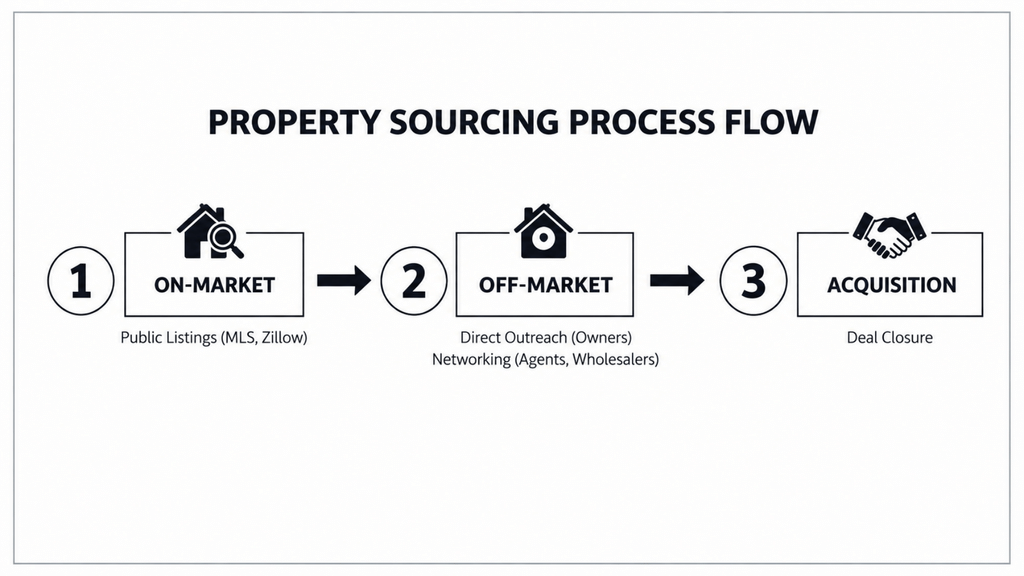
Experienced investors often combine several sourcing strategies instead of depending on one channel.
Direct Mail and Owner Outreach
Direct outreach allows investors to identify owners who fit specific acquisition criteria and contact them directly.
An investor might target properties based on location, asset type, ownership duration, size, occupancy, physical condition, or other indicators of potential opportunity.
The quality of the targeting matters.
Sending thousands of generic messages can produce less value than building a smaller list of owners whose properties genuinely fit the investor’s acquisition strategy.
The objective is also not necessarily to convince an owner to sell immediately.
Consistent outreach can build relationships with future sellers.
Networking and Industry Relationships
Relationships are one of the most important sources of private deal flow.
Investors can build connections with property owners, developers, lenders, property managers, contractors, attorneys, accountants, brokers, and other professionals who operate within their target market.
A strong network can surface opportunities that would be difficult to discover through public listings alone.
For example, a property manager may know that an owner is considering retirement, while a lender may know that an investor is restructuring a portfolio.
These situations do not guarantee a transaction, but they can open conversations that may eventually lead to an acquisition.
Wholesalers and Local Investors
Wholesalers and local investors can provide another source of potential acquisitions.
They often identify properties through direct marketing, owner relationships, or local market knowledge before presenting them to buyers.
Investors should still conduct their own underwriting.
A wholesale opportunity can be off market without being underpriced, and assignment fees or other transaction costs can affect the economics.
Agents and Brokers
Real estate agents can be valuable sources of private opportunities even when a property is not publicly listed.
Investors who clearly communicate their acquisition criteria can become easier for agents to match with potential sellers.
Rather than simply telling an agent that they are “looking for deals,” an investor can specify the markets, asset classes, property sizes, price ranges, financing preferences, and value-add characteristics they are targeting.
Specific criteria make it easier for professionals to recognize a relevant opportunity when one appears.
Driving for Dollars
Driving for dollars involves identifying properties in a target market that show characteristics worth investigating.
Signs such as deferred maintenance, vacancy, outdated buildings, or redevelopment potential may prompt an investor to research the property and its ownership.
The physical observation is only the first step.
Investors then need to verify ownership, understand the property, estimate its potential value, and determine whether contacting the owner makes sense.
Data and Property Research Tools
Property databases and research platforms can help investors identify ownership information, property characteristics, transaction history, and other indicators.
Data can make sourcing more systematic, but it should support, not replace, an investment strategy.
For example, an investor interested in value-add multifamily properties might use property data to identify assets with specific characteristics and then combine that information with direct outreach and local relationships.
The goal is not to build the largest property list, but a pipeline that fits the investor’s criteria.
How To Evaluate Off-Market Deals Fast
Finding a property privately does not eliminate the need for disciplined underwriting.
Because off-market opportunities may come with limited initial information, investors should quickly determine whether the property’s economics justify further due diligence.
A fast initial screen should answer these questions:
- What is the purchase price? Compare the seller’s expectations with comparable properties and the property’s underlying economics.
- What income does the property generate? Review rental income, occupancy, and other revenue sources.
- What are the operating expenses? Determine whether reported expenses are realistic and sustainable.
- What is the NOI? Net operating income provides a foundation for evaluating an income-producing property.
- What is the implied cap rate? Compare the property’s income relative to its purchase price with appropriate market benchmarks.
- What capital expenditures are required? Estimate repairs, renovations, deferred maintenance, and replacement costs.
- Where is the value-add opportunity? Consider whether improvements to the property, leasing, management, or operations can increase income or reduce expenses.
- How will the acquisition be financed? Debt terms can materially affect cash flow and investment returns.
- What is the exit strategy? Consider the property’s potential value, likely buyers, and realistic assumptions at the time of sale.
For example, Company A finds an off-market multifamily property offered for $5 million.
Although the owner highlights stable occupancy and current income, the investor discovers significant renovation needs and operating expenses that appear unusually low compared with similar properties.
Rather than evaluating the $5 million price in isolation, the investor should underwrite normalized expenses, renovation costs, financing, projected NOI, and the property’s potential value after stabilization.
The asking price only becomes meaningful when evaluated against the property’s income, condition, market conditions, financing requirements, and future performance.
For investors assessing potential acquisitions, Elkridge Real Estate can provide a broader perspective on valuation, financing, value creation, and exit considerations.
Where An Advisor’s Sourcing Fits
Knowing how to find off-market properties is only part of building a strong acquisition strategy.
The greater challenge is determining which opportunities fit the investor’s objectives and what can be done with the asset after acquisition.
This is where an end-to-end investment advisor can add value.
Elkridge Real Estate connects sourcing with acquisition analysis, financing, value creation, operations, and the eventual exit.
For example, an off-market commercial property may appear attractively priced compared with similar assets.
But the real investment decision depends on whether it can be financed efficiently, improved at a reasonable cost, and positioned for stronger performance and future value.
By evaluating these factors together, investors can avoid pursuing properties simply because they are off market and instead focus on opportunities that support a broader portfolio strategy.
Frequently Asked Questions
What does off market mean?
It means a property is not publicly listed or broadly marketed through the MLS, even though the owner may be willing to sell or considering a sale.
Investors can discover these properties through direct outreach, networking, agents, wholesalers, property data, and professional relationships.
Does Off Market Mean Sold?
No. Off market does not mean sold.
The term describes how a property is being marketed, not whether ownership has changed.
An owner may be considering a sale, negotiating privately, accepting offers, or simply willing to discuss a potential transaction.
How Do You Find Off-Market Deals?
Investors can find off-market deals through direct owner outreach, networking, real estate agents, wholesalers, driving for dollars, property research, and data tools.
Building relationships and maintaining consistent outreach can help investors discover opportunities before they are broadly marketed.
Disclaimer: This article is provided for educational purposes only and does not constitute investment, tax, or legal advice. Real estate investing involves risk, and outcomes may vary based on individual circumstances.
Any figures presented are illustrative examples only and should not be interpreted as projected returns. Consult a qualified professional before making any investment decision.